We regard our corporate heritage as an integral part of our responsibility to prevent and minimize potential impacts and risks to archaeological and cultural heritage during our operations, to support the safeguarding of cultural heritage, and to comply with applicable laws and regulations. In line with this approach, we aim to ensure that all Limak Cement employees and business partners are aware of and trained in the procedures for protecting cultural heritage and archaeological resources.
Cultural heritage encompasses movable and immovable objects, sites, groups of structures, natural features, and landscapes of archaeological, paleontological, historical, architectural, religious, aesthetic, or other cultural significance. A “chance find” refers to physical cultural heritage that is encountered unexpectedly in the course of operations.
Our corporate heritage management is implemented in alignment with relevant reference frameworks, primarily IFC Performance Standard 8 (Cultural Heritage) and Law No. 2863 on the Protection of Cultural and Natural Assets.
Roles and responsibilities are clearly defined. The CEO supports cultural heritage and chance find management, ensures the provision of strategic-level resources where necessary, and oversees the implementation of this guideline at the highest level.
Location Managers ensure that the guideline is implemented and monitored at site, coordinate the relevant teams, review chance find reports, and ensure that these are submitted to the competent authorities.
The Raw Materials Team closely monitors raw material areas for potential archaeological or cultural findings; in the event of a finding, the team immediately suspends activities and promptly informs the Sustainability/Environment team and management.
Reporting to the Location Managers, the Environment Team monitors the implementation of the guideline on site, coordinates the necessary environmental and safety measures in the event of a finding, and liaises with public authorities in accordance with national legislation.
The People, Culture and Sustainability Directorate coordinates the relevant documentation process and arranges chance find awareness training for employees through the Academy.
All factory/site employees commit to being able to recognize potential cultural heritage elements based on the training provided; to stop work and notify the Environment team as soon as possible in the event of a finding; and to secure the area without intervening at the find location.
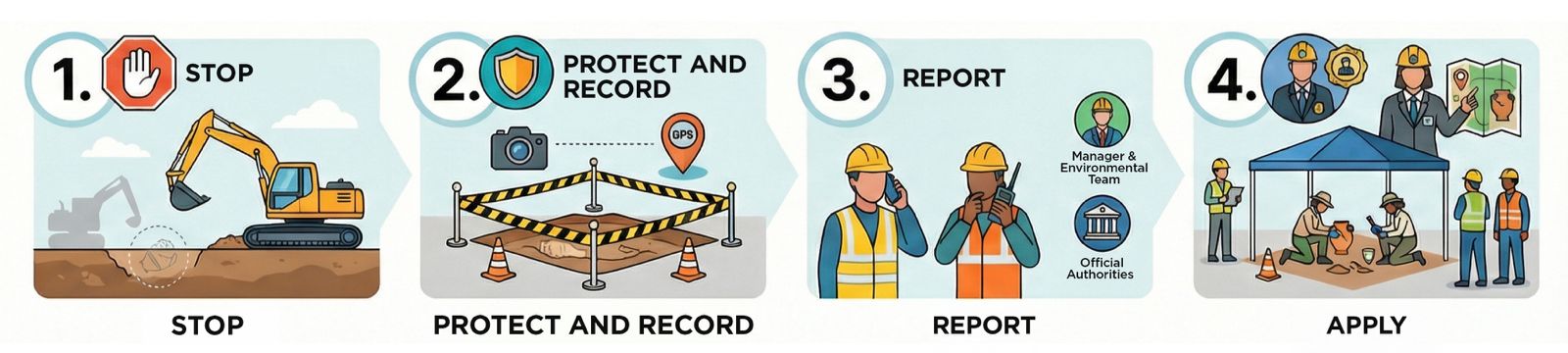
The actions to be taken in the event of a chance find are standardized at site. Construction and excavation activities are stopped immediately; the geographical coordinates of the find are recorded, photographs are taken, and the area is cordoned off with safety tape to prevent access. For an initial assessment, the relevant Provincial Museum Directorate and/or other competent local authorities are notified. The competent authority prepares a report for the Ministry of Culture and Tourism, together with the recommended actions; these actions are implemented in the presence of expert archaeologists and Ministry personnel.
To ensure the continuity of our corporate heritage approach, the training component is addressed separately. The People, Culture and Sustainability Directorate organizes in-person or online training to inform field personnel involved in construction and excavation activities, as well as Environmental Engineers, on cultural heritage matters. The training provides practical guidance on recognizing archaeological features and artifacts and ensures that employees act in accordance with cultural heritage management instructions. Training content includes the importance of cultural heritage and protective measures, documentation requirements for chance finds, a list of pre-identified archaeological sites/monuments/culturally sensitive areas within the proposed activity area, and photographs and descriptions of artifact types that may be encountered.